


Sleep in Chronic Fatigue
Sleep disturbances are among the most common symptoms experienced by people with chronic fatigue, regardless of the underlying cause. Whether related to ME/CFS, Long COVID, dysautonomia, chronic pain, or another medical condition, many people describe sleeping for adequate—or even prolonged—periods of time yet waking feeling completely unrefreshed.
Sleep problems in chronic fatigue are often different from primary insomnia. Research suggests that changes in autonomic function, neuroinflammation, sleep architecture, and the brain's restorative processes may all contribute to non-restorative sleep, even when routine sleep studies appear relatively normal.
This section includes information about sleep evaluation, cognitive behavioral therapy for insomnia (CBT-I), supplements and medications, treatment of common sleep disorders, emerging research (including the glymphatic system), and practical strategies frequently shared with patients in clinic.
Glymphatic Dysfunction in ME/CFS
One of the most promising newer areas of ME/CFS research involves the glymphatic system—the brain's waste clearance network. This system uses cerebrospinal fluid (CSF) to circulate through the brain, delivering nutrients while removing metabolic waste products, inflammatory molecules, and proteins that accumulate during normal brain activity. Unlike most organs, the brain does not have traditional lymphatic vessels throughout its tissue. Instead, it relies on this specialized CSF-based clearance system.
The glymphatic system is most active during deep (slow-wave) sleep. During this stage of sleep, spaces between brain cells expand, allowing CSF to flow more efficiently and remove waste products that accumulate while we are awake. Poor sleep, neuroinflammation, vascular dysfunction, and autonomic abnormalities may all interfere with this process.
New Imaging Evidence
For many years, impaired glymphatic function in ME/CFS was only a theoretical model. In 2026, researchers published the first direct neuroimaging evidence supporting this hypothesis using a specialized MRI technique called DTI-ALPS (Diffusion Tensor Imaging Along the Perivascular Space).
Compared with healthy controls, people with ME/CFS demonstrated significantly reduced markers of glymphatic function, suggesting less efficient clearance of waste products from the brain. Importantly, individuals with the greatest reduction in glymphatic function also tended to report more severe sleep disturbance and difficulty concentrating, two of the hallmark symptoms of ME/CFS. Similar abnormalities have also been observed in people with long COVID, providing additional evidence that impaired glymphatic clearance may contribute to post-infectious illnesses.
What Has Been Found in Cerebrospinal Fluid?
Researchers have also identified a number of measurable abnormalities within the cerebrospinal fluid of people with ME/CFS. While these findings are not yet used clinically, they provide additional evidence that the illness involves changes within the central nervous system.
Studies have reported:
• Changes in brain metabolism, including abnormalities in one-carbon metabolism, folate-related pathways, sphingomyelins, and other metabolites involved in energy production and myelin health.
• Evidence of immune activation, including elevated inflammatory signaling molecules such as eotaxin (CCL11) and distinct immune patterns that may represent different biological subtypes of ME/CFS.
• Alterations in proteins involved in complement activation, platelet function, neutrophil activity, and inflammation, particularly among patients with severe disease or coexisting POTS.
• Reduced levels of glutathione, an important antioxidant involved in protecting brain cells from oxidative stress.
• Reduced cerebral blood flow and elevated lactate within the brain, suggesting impaired energy metabolism and mitochondrial dysfunction.
Taken together, these findings suggest that ME/CFS is associated with measurable changes in the brain's immune environment, metabolism, and waste clearance systems.
Could Improving CSF Flow Become a Treatment?
Because glymphatic function depends on normal CSF circulation, some researchers have proposed that improving CSF dynamics might someday become a therapeutic strategy.
Several observations support this idea:
• Some patients with ME/CFS have features that overlap with idiopathic intracranial hypertension (IIH).
• Some individuals report temporary improvement after lumbar puncture, which removes a small amount of CSF.
• A published case report described significant improvement after surgical treatment of jugular venous outflow obstruction, which may have improved CSF circulation.
These observations have led researchers to propose that restoring CSF movement could potentially improve glymphatic clearance in selected patients.
However, this remains a research hypothesis. There have been no randomized clinical trials demonstrating that CSF drainage, lumbar puncture, or shunting is an effective treatment for ME/CFS. Procedures that permanently divert CSF carry substantial risks, including infection, shunt malfunction, intracranial hypotension, and the need for additional surgeries. At present, these procedures are not recommended as routine treatment for ME/CFS outside of appropriate evaluation for other neurological conditions.
Other Experimental Approaches
Researchers are also exploring therapies that may influence some of the biological abnormalities seen in ME/CFS, although none have yet become established treatments.
These include extracorporeal apheresis to remove certain circulating autoantibodies, plasmalogen replacement therapy aimed at restoring membrane lipids involved in brain and immune function, and additional therapies designed to reduce neuroinflammation or improve mitochondrial energy production. At present, these approaches remain investigational.
What Does This Mean for Patients?
The discovery of impaired glymphatic function represents an important step toward understanding the biology of ME/CFS. Rather than viewing symptoms such as cognitive dysfunction, unrefreshing sleep, and sensory overload as isolated problems, researchers are increasingly studying how changes in sleep physiology, autonomic function, cerebral blood flow, neuroinflammation, and CSF circulation may interact to produce the illness.
This research is still in its early stages. While it offers exciting new insights into how ME/CFS affects the brain, it has not yet led to proven glymphatic- or CSF-targeted treatments. Future studies will determine whether these findings can be translated into safe and effective therapies and whether specific biological subtypes of ME/CFS are more likely to benefit from targeted interventions.

Outline of the glymphatic system. This figure illustrates that perivascular clearance comprises perivascular drainage and glymphatic pathways. (1) Cerebrospinal fluid flows into the brain parenchyma via the periarterial space, which is the perivascular space surrounding the parenchymal arteries. From this perivascular space surrounding the artery, cerebrospinal fluid enters the interstitium of the brain tissue via aquaporin 4 (AQP4)-controlled water channels. These are distributed in the end feet of astrocytes that constitute the outer wall of the perivascular space. (2) Cerebrospinal fluid entering the interstitial fluid flows by convection, and the cerebral spinal fluid (CSF)-interstitial fluid (ISF) exchange within the brain parenchyma. (3) After washing the waste proteins from the tissue, it flows into the perivenous space, which is the perivascular space around the deep-draining vein, and is subsequently discharged outside the brain. 22,23 (Reprinted by permission from Macmillan Publishers Ltd: Nat Rev Neurol [11:457-470], copyright [2015]).

Sleep Evaluation
Many people with chronic fatigue assume that poor sleep is simply "part of the illness." While non-restorative sleep is common in conditions such as ME/CFS and Long COVID, it is important not to stop the evaluation there. Treatable sleep disorders frequently coexist with chronic fatigue and can worsen symptoms, cognitive dysfunction, autonomic instability, pain, and post-exertional malaise.
Studies have found that up to one-third to one-half of patients referred with a presumed diagnosis of ME/CFS or chronic fatigue actually have an identifiable primary sleep disorder such as obstructive sleep apnea (OSA), periodic limb movement disorder (PLMD), restless legs syndrome (RLS), or chronic insomnia. Treating these conditions may not completely resolve fatigue, but it often improves sleep quality, daytime functioning, and overall quality of life.
Step 1: Start with a Detailed Sleep History
A careful sleep history is often the most valuable part of the evaluation. Y
our clinician may ask about:
• Bedtime, wake time, and whether these differ on workdays versus weekends
• How long it takes to fall asleep
• How often you wake during the night
• Whether you wake feeling refreshed
• Napping habits
• Daytime sleepiness versus physical fatigue (these are not the same thing)
• Snoring, gasping, choking, or witnessed pauses in breathing
• Restless legs, uncomfortable sensations before sleep, or nighttime leg movements
• Shift work, travel, or irregular sleep schedules
• Medications, alcohol, caffeine, cannabis, and supplements that may affect sleep
• Anxiety, pain, urinary frequency, reflux, itching, or other symptoms that disrupt sleep
Sleep diaries kept for one to two weeks can often identify patterns that are difficult to recognize from memory alone.

From the American Academy of Family Physicians (AAFP) Article on Fatigue Workup
Step 2: Screen for Common Sleep Disorders
Obstructive Sleep Apnea (OSA)
OSA occurs when the upper airway repeatedly collapses during sleep, causing brief interruptions in breathing and fragmented sleep.
Symptoms may include:
• Loud snoring
• Witnessed pauses in breathing
• Gasping or choking during sleep
• Morning headaches
• Dry mouth upon waking
• Excessive daytime sleepiness
Risk factors include obesity, older age, larger neck circumference, craniofacial anatomy, and certain medical conditions, although OSA can occur in people without these risk factors.
Common screening tools include:
• STOP-BANG questionnaire
• Epworth Sleepiness Scale (ESS)
Restless Legs Syndrome (RLS)
RLS causes an uncomfortable urge to move the legs, usually:
• Worse at night
• Worse while sitting or lying still
• Relieved by movement
RLS is commonly associated with low iron stores, even when the blood count is normal. Many clinicians recommend checking a ferritin level, with a target ferritin of at least 50–75 ng/mL in symptomatic patients.
Periodic Limb Movement Disorder (PLMD)
PLMD involves repetitive, involuntary leg movements during sleep that may fragment sleep without the patient realizing it.
Patients often report:
• Unrefreshing sleep
• Frequent nighttime awakenings
• Excessive fatigue
A bed partner may notice repetitive kicking or jerking movements overnight.
Unlike RLS, PLMD cannot be diagnosed based on symptoms alone and requires an overnight sleep study.
Circadian Rhythm Sleep-Wake Disorders
Sometimes the problem is not the amount of sleep but when the body wants to sleep.
Examples include:
• Delayed sleep-wake phase ("night owl")
• Advanced sleep phase ("early bird")
• Irregular sleep-wake rhythm
• Non-24-hour sleep-wake rhythm
Clues include:
• Difficulty falling asleep at conventional times
• Difficulty waking for work or school
• Sleeping much better on weekends or vacations
• Consistently drifting to later bedtimes
These disorders are particularly important to recognize because treatment differs substantially from treatment for insomnia.
Chronic Insomnia
Insomnia may involve:
• Difficulty falling asleep
• Difficulty staying asleep
• Waking earlier than desired
• Feeling unable to return to sleep
Many people with chronic fatigue have insomnia in addition to non-restorative sleep, and both conditions should be addressed separately.
Step 3: Actigraphy
Actigraphy is a wrist-worn monitor (similar to a smartwatch or fitness tracker) that estimates sleep and activity over time.
Unlike a single overnight sleep study, actigraphy is usually worn continuously for at least 7 days, and sometimes 2 weeks or longer when a circadian rhythm disorder is suspected.
Actigraphy can estimate:
• Sleep timing
• Total sleep time
• Sleep efficiency
• Time spent awake after falling asleep
• Night-to-night variability
• Rest-activity patterns
This is especially useful in chronic fatigue because many patients have marked variability from night to night, which may be missed during a single laboratory sleep study.
Actigraphy is particularly helpful when evaluating delayed sleep phase syndrome or other circadian rhythm disorders.
It is important to recognize its limitations. Actigraphy cannot reliably diagnose sleep apnea, accurately detect periodic limb movements, or determine sleep stages.
Step 4: Sleep Studies (Polysomnography)
An overnight polysomnogram (PSG) remains the gold standard for diagnosing many sleep disorders.
A PSG records:
• Brain waves (EEG)
• Eye movements
• Muscle activity
• Heart rhythm
• Breathing
• Oxygen levels
• Body position
• Leg movements
A sleep study may identify:
• Obstructive sleep apnea
• Central sleep apnea
• Periodic limb movement disorder
• Parasomnias
• Nocturnal seizures
• Other causes of fragmented sleep
For many people with chronic fatigue, the sleep study may appear relatively "normal" despite severe symptoms. This does not mean the symptoms are psychological or imagined. Research increasingly shows that conventional sleep studies may miss more subtle abnormalities in sleep stability, autonomic regulation, and sleep microarchitecture that contribute to non-restorative sleep.
Home Sleep Apnea Testing (HSAT)
For people with a high likelihood of uncomplicated obstructive sleep apnea, a home sleep apnea test may be appropriate.
However, HSAT:
• Does not measure sleep stages
• Does not diagnose PLMD
• Does not evaluate many neurological sleep disorders
• May underestimate sleep apnea severity
If a home test is negative but clinical suspicion remains high, an in-laboratory sleep study is generally recommended.
Step 5: Circadian Rhythm Testing
When a circadian rhythm disorder is suspected, additional evaluation may include:
• Sleep diaries
• Extended actigraphy
• Dim-light melatonin onset (DLMO) testing, which measures the body's internal biological clock using evening saliva samples
DLMO testing is primarily used in specialty sleep medicine clinics but can be useful when the diagnosis remains uncertain or when precisely timed light therapy or melatonin treatment is being considered.
Additional Testing
Depending on the clinical picture, your healthcare provider may also consider laboratory evaluation for conditions that commonly contribute to poor sleep or fatigue, including:
• Iron deficiency (particularly ferritin for RLS)
• Vitamin B12 deficiency
• Folate deficiency
• Vitamin D deficiency
• Thyroid disorders
• Diabetes
• Kidney disease
• Medication side effects
• Mood disorders
These conditions often coexist with chronic fatigue and may worsen sleep quality.
Sleep Evaluation in ME/CFS and Long COVID
People with ME/CFS and Long COVID often have a distinctive pattern of sleep disturbance. They may spend longer in bed, take longer to fall asleep, experience reduced sleep efficiency, and wake feeling profoundly unrefreshed despite obtaining an apparently adequate amount of sleep.
Research also suggests abnormalities in autonomic nervous system activity during sleep, altered stress hormone regulation, neuroinflammation, and—more recently—impaired glymphatic function, the brain's waste-clearance system that is most active during deep sleep. These findings may help explain why many people continue to experience severe fatigue even after common sleep disorders have been identified and treated.
Bottom Line
Evaluating sleep in chronic fatigue is about much more than asking, "How many hours do you sleep?" A comprehensive assessment should screen for common sleep disorders, evaluate circadian rhythm, consider objective testing such as actigraphy or polysomnography when appropriate, and recognize that people with ME/CFS and related illnesses often have biologically altered sleep that may not be fully captured by standard sleep studies. Identifying and treating coexisting sleep disorders can meaningfully improve quality of life, even if they are not the sole cause of chronic fatigue.
CBT-I and Behavioral Strategies
Many people with chronic fatigue describe feeling "exhausted but unable to sleep" or sleeping for hours without feeling refreshed. While there is no behavioral treatment proven to reverse the underlying sleep abnormalities seen in ME/CFS or Long COVID, addressing insomnia and improving sleep quality can still meaningfully improve quality of life.
Cognitive Behavioral Therapy for Insomnia (CBT-I) is considered the first-line treatment for chronic insomnia by the American Academy of Sleep Medicine. Importantly, research suggests that CBT-I remains effective even when chronic fatigue is present. However, standard CBT-I often requires thoughtful modification for people with ME/CFS, Long COVID, and other fatiguing illnesses to avoid worsening symptoms or triggering post-exertional malaise (PEM).
It is also important to recognize that treating insomnia does not necessarily treat chronic fatigue. Fatigue and insomnia overlap, but they are only partially related. Many people experience improvement in one while the other persists, which is why both sleep and fatigue often need to be addressed separately.
What is CBT-I?
CBT-I is a structured, evidence-based treatment that helps retrain the brain's relationship with sleep. Rather than relying primarily on medications, it uses behavioral and cognitive strategies to improve sleep quality over time.
The core components include:
• Stimulus control
• Sleep scheduling (sometimes called sleep restriction or sleep compression)
• Cognitive restructuring
• Sleep hygiene
• Relaxation training
• Circadian rhythm stabilization
Most CBT-I programs last 6–8 weeks and can be completed with a trained therapist or through validated online programs.
Modifying CBT-I for Chronic Fatigue
Standard CBT-I was developed primarily for people with chronic insomnia—not for people with illnesses characterized by profound fatigue or post-exertional malaise.
Use Caution with Sleep Restriction
Sleep restriction is often the most effective part of CBT-I, but it is also the component that deserves the most caution in ME/CFS and similar conditions.
Traditional CBT-I intentionally reduces time spent in bed to build stronger "sleep drive." During the first few weeks, people often become temporarily sleepier during the day before sleep improves.
For someone with ME/CFS or Long COVID, this temporary sleep deprivation may worsen:
• Fatigue
• Brain fog
• Orthostatic intolerance
• Pain
• Post-exertional malaise (PEM)
Rather than aggressive sleep restriction, many clinicians favor a gentler sleep compression approach, including:
• Maintaining a reasonable minimum sleep opportunity
• Making smaller schedule adjustments
• Progressing more slowly
• Pausing adjustments during significant symptom flares
The goal is to improve sleep efficiency without pushing the body into PEM.
Stimulus Control
Stimulus control helps strengthen the association between the bed and sleep.
Typical recommendations include:
• Use the bed primarily for sleep (and sex).
• Maintain a consistent wake time.
• Avoid working, eating, or scrolling on your phone in bed whenever possible.
• If unable to sleep after 20–30 minutes, do a quiet, non-stimulating activity until sleepy.
For people with severe fatigue or mobility limitations, leaving the bedroom repeatedly may not be realistic. Instead, simply sitting upright in bed, reading quietly, listening to calming audio, or practicing relaxation techniques may accomplish the same goal without unnecessary physical exertion.
The "Tired but Wired" Phenomenon
One of the most common experiences in chronic fatigue is feeling profoundly exhausted while simultaneously feeling unable to fall asleep.
Many patients describe:
• Physical exhaustion
• Mental hyperarousal
• Racing thoughts
• Feeling "too tired to sleep"
This state likely reflects persistent autonomic nervous system activation rather than simply poor sleep habits.
Helpful strategies include:
• A consistent 30–60 minute wind-down routine
• Dim lighting before bed
• Gentle stretching if tolerated
• Relaxation recordings
• Audiobooks or calming podcasts
• White noise, nature sounds, or soft music
• Avoiding emotionally activating conversations, work, or household chores immediately before bed
The goal is not simply to become tired—but to help the nervous system transition from an alert state into a sleepy one.
Relaxation Techniques
Relaxation therapies are a core part of CBT-I and can be particularly helpful for sleep-onset difficulty.
Examples include:
• Progressive muscle relaxation
• Diaphragmatic breathing
• Guided imagery
• Meditation
• Body scans
• Yoga nidra (if tolerated)
Some people also benefit from long-form audio recordings that provide a gentle focus while falling asleep, reducing rumination without requiring active concentration. YouTube has lots of these.
Sleep Hygiene
Sleep hygiene alone rarely cures chronic insomnia, but it provides a foundation for healthy sleep.
Helpful habits include:
• Keeping a consistent wake time
• Getting morning light exposure when possible
• Limiting bright light before bed
• Avoiding excessive caffeine later in the day
• Limiting alcohol close to bedtime
• Keeping the bedroom cool, dark, and quiet
• Using the bed primarily for sleep
For patients who are homebound or spend much of the day resting, simple cues can help reinforce the body's internal clock:
• Wear daytime clothes while awake.
• Change into sleepwear only at bedtime.
• Open blinds during the day.
• Keep daytime and nighttime environments visually distinct.
These small behavioral cues help strengthen circadian signals even when overall activity levels are low.
Activity Pacing and Sleep
Sleep and daytime activity influence each other.
Many people with chronic fatigue fall into a "boom-and-bust" cycle, feeling slightly better one day, doing too much, then experiencing worsened symptoms and poor sleep for several days afterward.
Activity pacing aims to interrupt this cycle by:
• Staying within your energy envelope
• Taking planned rest breaks before symptoms become severe
• Alternating physical, cognitive, and social activities
• Avoiding large swings in activity
• Gradually increasing activity only when symptoms remain stable
Keeping a simple diary that tracks activity, symptoms, and sleep can often reveal patterns that are otherwise difficult to recognize.
CBT for Fatigue Is Different from CBT-I
CBT-I focuses on insomnia.
CBT for fatigue (sometimes called CBT-F) focuses on:
• Managing activity patterns
• Reducing fear of symptom flares
• Identifying unhelpful thinking patterns
• Improving coping strategies
• Preventing the boom-and-bust cycle
Although these approaches overlap, they target different problems.
Someone may sleep substantially better after CBT-I yet remain physically limited by ME/CFS. Likewise, improving pacing and fatigue management does not necessarily eliminate insomnia. For many people, addressing both sleep and fatigue produces the greatest overall improvement.
Digital CBT-I
Many evidence-based CBT-I programs are now available online, making treatment accessible even for people who are homebound or live far from a sleep specialist.
Digital CBT-I generally includes:
• Weekly educational modules
• Sleep diaries
• Personalized sleep scheduling
• Cognitive exercises
• Relaxation training
Studies suggest these programs can be highly effective for chronic insomnia and remain beneficial even when chronic fatigue is present.
Bottom Line
CBT-I remains the most effective non-medication treatment for chronic insomnia and can be very helpful for people with chronic fatigue who also struggle with difficulty falling asleep or staying asleep. However, because ME/CFS and related illnesses involve unique biological changes—including post-exertional malaise, autonomic dysfunction, and non-restorative sleep—standard CBT-I often benefits from thoughtful modification. Combining insomnia treatment with activity pacing, relaxation techniques, and individualized management of the underlying illness is often more effective than relying on any single strategy alone.
9 hour ancient civilization documentary for sleep, no ads, no AI
8 hour delta-wave sleep music (no ads, no AI)
30 minute theta-wave "power nap" (No Ads, no AI)
Important: This is not a traditional CBT program and should not be considered an evidence-based medical treatment for ME/CFS. It falls more into the "brain retraining/neuroplasticity" category, which remains controversial.
FREE CBT-I with a six-session evidence-based program. One of the best-studied digital CBT platforms for insomnia
Important: This is not a traditional CBT program and should not be considered an evidence-based medical treatment for ME/CFS.This technique focuses on osteopathic maneuvers to manipulate CSF flow, which MAY be helpful given the new understandings of the glymphatic system in ME/CFS
Medications for Sleep
There are currently no FDA-approved medications specifically for the sleep disturbances of ME/CFS or Long COVID. Instead, treatment is individualized based on a person's specific sleep complaints, coexisting conditions (such as pain, restless legs syndrome, or anxiety), medication tolerability, and overall goals. While medications can improve insomnia, they have not been shown to consistently reverse the non-restorative sleep that is a hallmark of ME/CFS.
Whenever possible, medications should be combined with treatment of underlying sleep disorders (such as obstructive sleep apnea or restless legs syndrome), circadian rhythm optimization, pacing, and behavioral strategies such as CBT-I.
Choosing a Medication
The table below summarizes commonly used medications based on the patient's predominant sleep complaint and coexisting conditions. These are not formal treatment guidelines, but rather a practical framework that may help guide discussions with your healthcare provider.

Melatonin
Melatonin is often the first medication people try because it is inexpensive, generally well tolerated, and available over the counter.
Melatonin works best for circadian rhythm disorders (such as delayed sleep phase) rather than as a general sleeping pill. Research in ME/CFS suggests that patients with delayed melatonin secretion may experience improvements in fatigue, concentration, and activity when melatonin is timed appropriately. Simply taking melatonin immediately before bed may not provide the same benefit.
Lower doses (approximately 0.5–1 mg) are often sufficient for circadian phase shifting, while higher doses (3–5 mg) may provide a greater sleep-promoting effect.
Low-Dose Tricyclic Antidepressants
Low-dose amitriptyline (typically 10–25 mg at bedtime) has been used for decades in patients with chronic pain syndromes, fibromyalgia, migraine, and ME/CFS.
Potential benefits include:
• Improved sleep continuity
• Reduced pain
• Migraine prevention
• Modest improvements in fatigue for some patients
However, side effects—including dry mouth, constipation, urinary retention, weight gain, and morning grogginess—limit its usefulness for some people.
Cyclobenzaprine, a muscle relaxant with a similar chemical structure, is sometimes used as an alternative, particularly when muscle pain or tension predominates, although evidence for improving sleep itself is less convincing.
Trazodone
Low-dose trazodone (25–100 mg) is one of the most commonly prescribed medications for chronic insomnia.
Many patients find that it:
• Reduces nighttime awakenings
• Improves overall sleep quality
• Produces relatively little dependence
Morning grogginess and dry mouth are common. Although uncommon, trazodone has occasionally been reported to worsen restless legs syndrome or periodic limb movements, making it a less attractive option when those conditions are suspected.
Orexin Receptor Antagonists
The newest class of prescription sleep medications includes:
• Suvorexant
• Lemborexant
• Daridorexant
Rather than acting as traditional sedatives, these medications block orexin, one of the brain's primary wake-promoting neurotransmitters.
This mechanism is particularly interesting in ME/CFS because many patients describe feeling "tired but wired"—physically exhausted but unable to transition into sleep. Orexin antagonists target this state of hyperarousal more directly than older sleep medications.
Compared with benzodiazepines and "Z-drugs," they generally have:
• Lower risk of dependence
• Less disruption of normal sleep architecture
• Better long-term safety
Early studies in fibromyalgia have also shown improvements in pain and sleep quality, making this class especially promising for patients with overlapping chronic pain conditions. Research specifically in ME/CFS is still lacking.
Gabapentin and Pregabalin
These medications are often useful when insomnia occurs alongside:
• Chronic pain
• Fibromyalgia
• Restless legs syndrome
• Peripheral neuropathy
• Periodic limb movements
Unlike many sleeping pills, gabapentin and pregabalin also increase slow-wave (deep) sleep and can improve sleep maintenance.
The tradeoff is that they may also cause:
• Morning sleepiness
• Dizziness
• Brain fog
• Weight gain
These side effects can be particularly limiting in people who already experience cognitive dysfunction from ME/CFS.
Low-Dose Doxepin
Low-dose doxepin (3–6 mg) is FDA-approved specifically for insomnia.
Unlike higher doses used as an antidepressant, these very low doses primarily block histamine receptors and are particularly helpful for people who:
• Fall asleep easily
• Wake repeatedly during the night
• Wake too early in the morning
Because the dose is so low, anticholinergic side effects are much less common than with amitriptyline. However, it is rarely covered by insurance, and most pharmacies do not carry the lower dose. Because of this, it either needs to be compounded at a specialty pharmacy or modified in some way from the commercially available form to get the low dose needed.
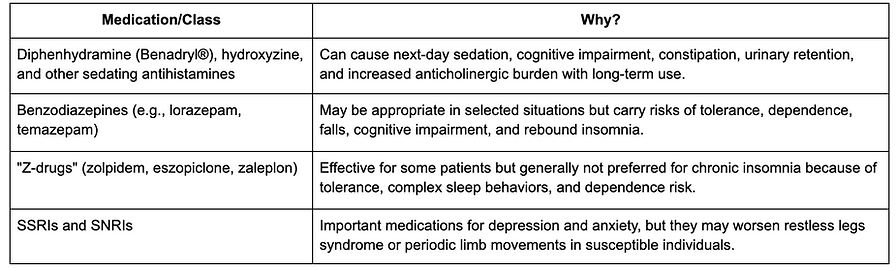
Medications to Use With Caution
Some medications can unintentionally worsen sleep disorders or create additional problems.
Supplements for Sleep
Many people with ME/CFS, Long COVID, and other chronic fatiguing illnesses are interested in supplements that may improve sleep. While several supplements have shown promise, none have been proven to reverse the non-restorative sleep that characterizes ME/CFS, and the quality of evidence varies considerably.
In general, supplements work best when targeted to a specific problem—for example, melatonin for circadian rhythm disorders or iron for restless legs syndrome—rather than as universal sleep aids.
